
Concrete Mix
The mix must be workable and set-up with the appropriate timing. Here are some potential problems and information to help you correct them:
1st Aid for Concrete Problems:
Most problems can be fixed with a prepackaged Admixture (Fritz-Pak Corporation).
- Warm temperature and concrete is setting too quickly - Add a retarder to give more time to finish the concrete before it hardens.
- Concrete is not workable - To improve work-ability and durability without increasing the water content, add a super plasticizer (water reducer) and a finishing aid that enhances surface finishing characteristics.
- Avoid: Products that contain calcium chloride or chloride ions which may discolor colored concrete.
- Pozzolans - This admixture improves finish-ability, reduces permeability and efflorescence (concrete salts coming to the surface causing white blotches) and minimizes the bleeding of color. Pozzolans may also cause retardation, so this is something you need to be aware of when using.
- Cool temperatures - Use an accelerator to speed up the set time.
- Concrete that will be exposed to freezing and thawing - Use an air-entraining agent.
The directions on the back of the packages of the admixtures show the concrete mixing ratios.
It's important to try and keep the water content as low as possible without sacrificing work-ability. The lower the water content, the better the concrete will have these characteristics:
- Increased compressive strength and durability
- Lower permeability which will increase resistance to chemical attack - commonly happens through deicing salts
- Less volume change from wetting and drying
- Reduced shrinkage and cracking
Stamping Concrete Mix
Use a "thick mix" - one with sufficient amount of cement paste to provide a surface that takes imprints well. Generally, 5 1/2 to 6 bags of cement per cubic yard of concrete.
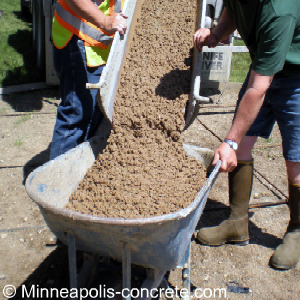

The larger the nominal aggregate size, the less the concrete will shrink. Look for a maximum aggregate size of 3/4 inch, or 1/2 inch if you're using a pattern with a deep reveal. Avoid using straight pea rock mix (3/8 inch aggregate) - especially if the concrete is 5 or 6 inches thick.


 |

License # BC721668
New! Comments
Have your say about what you just read! Leave me a comment in the box below.